
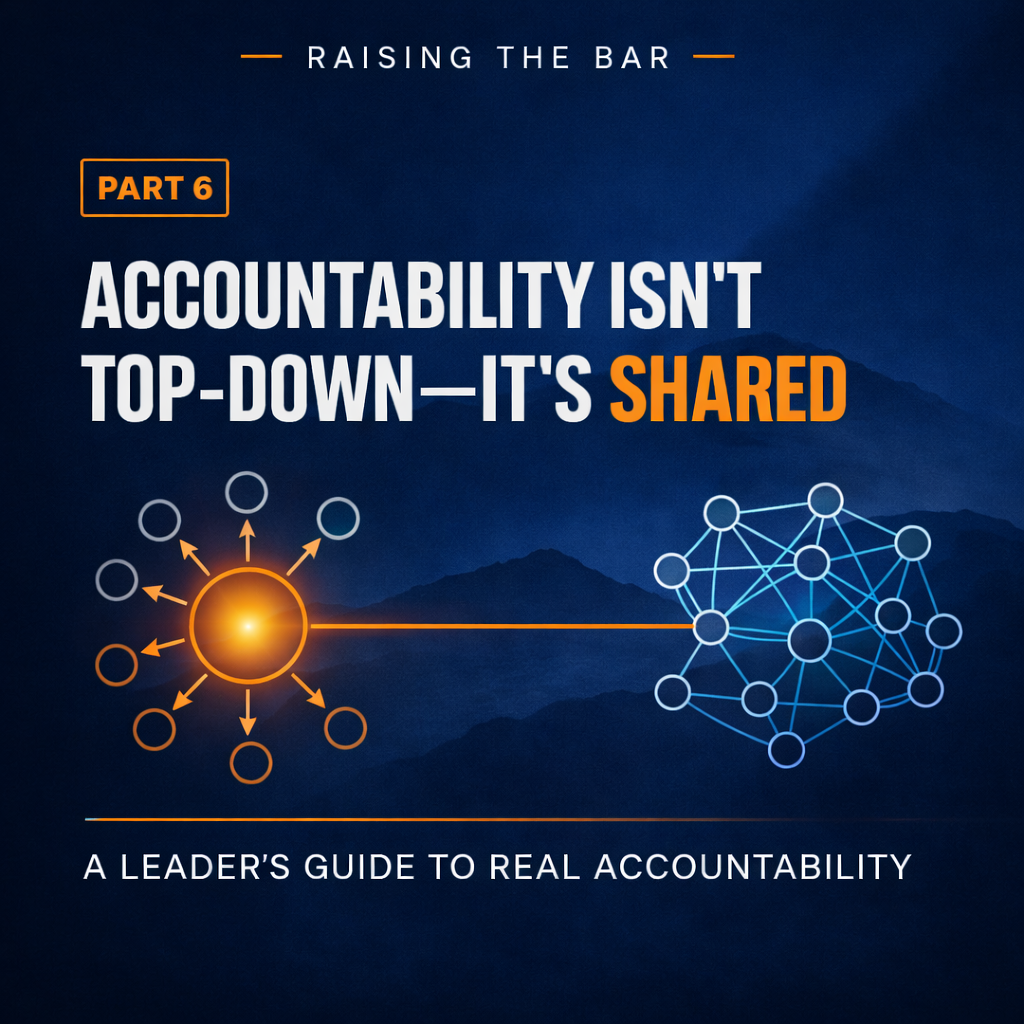
Accountability Isn’t Top-Down — It’s Shared
Raising the Bar Series | Part 6
To build accountability on your team, setting the standard matters.
Holding the standard matters.
But if it all depends on you…
It won’t scale.
Most leaders, often without realizing it, centralize accountability.
They become:
- the reminder system
- the escalation point
- the final decision-maker
And over time, everything starts to run through them.
At first, it feels like control.
Quickly though, it becomes a bottleneck.
The Hidden Cost of Centralized Accountability
When accountability sits with the leader:
- People wait instead of act
- Ownership gets fuzzy
- Performance depends on follow-up, not commitment
You don’t build accountability.
You build dependency.
And dependency slows everything down.
What Real Accountability Looks Like
Real accountability shows up differently.
- Team members hold themselves to the standard
- Peers hold each other to the standard
- Follow-through happens without constant oversight
The leader is still present, but not at the center of every interaction.
That’s when accountability starts to scale and become part of the organization’s DNA.
A Pattern I See Often
I worked with a leader who was deeply committed to high performance.
Clear expectations were in place. The standards were strong.
But, he had not built accountability into the cultural fabric, every decision, every follow-up, every issue still came back to him.
The team wasn’t underperforming….they were waiting.
Waiting for direction.
Waiting for approval.
Waiting for the boss to step in.
We shifted the focus.
Instead of reinforcing accountability to him, we built accountability within the team:
- Clear ownership of decisions
- Expectations that peers would challenge and support each other
- Space for the team to resolve issues before escalating
The result?
Faster decisions.
Stronger ownership.
Less friction.
A leader who was no longer the bottleneck, and a team that is accountable.
The Leader’s Role Has to Shift
This is where many leaders get stuck.
They say they want accountability…
But they still hold the reins.
Real accountability requires a shift:
You are no longer the enforcer.
You become:
- the architect of the system
- the model of the standard
- the one who reinforces—not rescues
The Standard Still Holds
Let’s be clear, this isn’t about lowering the bar.
It’s about everyone holding the bar.
When accountability is shared:
- standards stay high
- expectations stay clear
- ownership moves to where the work actually happens
That’s where performance lives.
The Bottom Line
If accountability depends on you, it’s fragile.
If it lives in the team, it scales.
Invitation
If you’re finding that everything still runs through you…
that’s not a people problem. It’s a system problem.
And it’s fixable.
I work with leaders to build accountability that doesn’t rely on constant oversight, so performance becomes consistent, scalable, and owned by the team.
If that’s a shift you’re ready to make, let’s connect.