
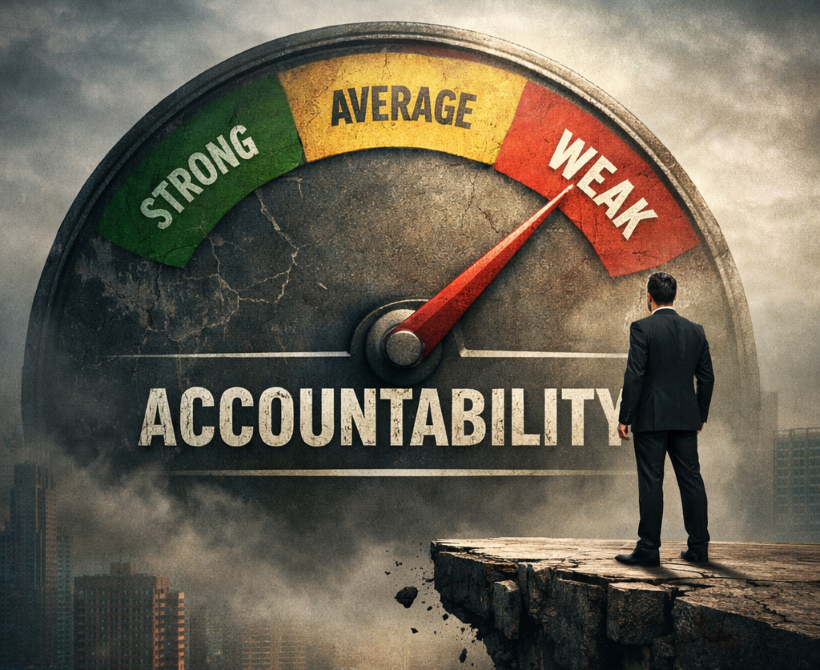
Raising the Bar: A Leader’s Guide to Real Accountability
Blog #1: Accountability Is Leadership’s Greatest Weakness—Here’s Why It Matters
Let’s be honest.
Most leaders struggle to hold people accountable. Most teams would agree.
Recent research from Gallup found that accountability is the lowest-rated leadership competency as reported by leaders and by the people they lead.
That alignment is rare, and it should get your attention.
Because when both sides agree something is missing, it’s not a perception issue. It’s a leadership gap.
Why Accountability Breaks Down
Accountability sounds simple: set expectations, follow through, address gaps.
But in practice, it’s where even experienced and confident leaders hesitate.
Not because they don’t care about performance, but because accountability requires tension:
- Being clear when expectations aren’t met
- Addressing inconsistency directly
- Holding the same standard across the team
And that’s where things drift.
Leaders soften the message – wanted to appear empathic. They delay the conversation. They make exceptions that feel reasonable in the moment.
Over time, those small decisions compound. Everyone is watching.
Clarity fades. Standards become uneven. And accountability turns into something situational instead of consistent.
The Cost of Getting It Wrong
When accountability is weak, you don’t just get lower performance, you get confusion.
- People aren’t sure what “good” looks like
- High performers start to question the environment and the standards
- Teams spend more time navigating ambiguity than delivering results
In fact, leaders who are strong at accountability see dramatically higher engagement on their teams.
That’s not a coincidence.
Clarity drives focus. Consistency builds trust. Accountability reinforces both.
Without it, even the best strategy struggles to execute.
The Misconception Leaders Hold
Here’s where many leaders get it wrong:
They associate accountability with pressure.
So they try to balance it by softening expectations—especially when they want to lead with empathy or maintain strong relationships.
But accountability isn’t about pressure.
Accountability is about clarity.
Clear expectations. Clear standards. Clear follow-through.
You don’t build trust by lowering the bar. You build trust by making the bar visible and holding it consistently.
The Leadership Standard
The strong leaders I talk to understand something that often gets missed:
Fair isn’t being flexible. Fair is being consistent.
Every time you allow the standard to shift based on the situation, you send a signal, whether you intend to or not, creating ambiguity.
And your team pays attention. They likely discuss the “double-standard”.
Not just to what you say, but to what you reinforce… and what you let go.
A Better Way to Think About It
If you want a simple way to reframe accountability, start here:
- The bar doesn’t move. The support does.
- Clarity creates accountability.
- Consistency builds trust.
That’s the work.
Not just setting expectations once – but reinforcing them every day through how you lead, communicate, and follow through.
Where This Series Is Going
Accountability isn’t a single conversation or a performance review cycle.
It’s a leadership discipline that it essential for every leader.
In this series, we’ll explore:
- What accountability really means in practice
- How to set and hold standards without damaging trust
- How to lead with empathy without lowering the bar
- And how to make accountability part of how your team operates every day
An Invitation
Take a moment and reflect:
Where might your standards be less clear than you think? And where might inconsistency be sending a message you didn’t intend?
That’s where accountability begins.
If you’re thinking about how this shows up in your leadership – or your team – this is the kind of work I explore with leaders every day. Happy to continue the conversation.